Month: December 2008

  • Report from the center of India

    Hello all,

    Anjali and I have been spending our last couple days in the dead center of India: Jabalpur, Madhya Pradesh.  This is where Anjali’s maternal grandmother and uncles live, and a place that doesn’t receive many foreign visitors, unless they are on their way to the Kanha National Park wilderness preserve to see the tigers. We arrived on a sunny Christmas Eve, and before long were sharing a meal with her grandmother and her uncle Ajit at the historic family home.  Later in the evening we met up with Anjali’s uncle Suresh and his wife, daughter, and her boyfriend for some late evening socializing.  June Aunty served us amazing homemade non-alcholic ginger wine while we sat and chatted.  Exquisite.  Liquid ginger goodness.

    Christmas day in Jabalpur was an absolutely unique experience.  Anjali’s Indian family converted to Christianity several generations back, so we went with her uncle to Christmas service and an early morning christening of one of distant infant relative at the Church of North India Diocese of Jabalpur.  In order to make the christening we were up with the dawn, which took some effort, since we hadn’t recovered from the poor quality sleep we got on the overnight train ride to Jabalpur the night before.  The father of the baptised infant is currently working in Dubai, and he came back with his family to christen the baby in his family home of Jabalpur.  He insisted we come to the christening reception that evening at the high-end Narmada Jacksons Hotel.  Well, if you insist.  He was a very sweet man.

    We then met the priest, who proceeded swiftly to insist that Anjali’s mother needed to be sending money to the church every year in order to stay on the church rolls, and then he quickly excused himself.  Having been raised Christian, but having only attended three services in the last 18 years (all Christmas or Christmas Eve services, naturally), my brief meeting with the priest quickly reminded me of the standard priority of Christian churches, no matter what continent in which they operate.

    The services were conducted in English, broadcast over a series of popping loudspeakers in a large and well-kept, high-ceilinged nave facing a wall of stained glass windows beyond the altar.  I appeared to be the only whitey in attendance, although there were some light-skinned Anglo-Indians at the service.  I recognized about half of the Christmas hymns, and the church organ provided a sense of childhood familiarity.  Having not attended a Christian service in a long time, I realized that it involves a lot of standing up and sitting down, and standing up and sitting down.  This happened hesitantly and in pockets, taking the whole congregation a while to figure out what they should be doing at any one moment.  The sermon involved a lot of references to terrorism and the Mumbai attacks, but I couldn’t make out a lot of what was said over the crackling, distorted loudspeakers.  There was a plaque in the church dedicated to Anjali’s grandfather Shamrao Hivale, and I took several pictures of her underneath it.  We ate freshly-fried bhajiyas and jaleebis that were being whipped up in vats of oil behind a food tent next to the church, while we were introduced to a sucession of Anjali’s distant relations.  Best after-church snacks ever, and good chai too.  We then picked up Anjali’s grandmother and visited Anjali’s grandfather’s grave, where she and her uncle placed flowers and lit candles.

    We then went over to Suresh’s home for a Christmas meal of desi khanna, including Cherida’s “Himachal-style” fried bhindi and a bunch of homemade Christmas snacks including “grape wine,” “guava cheesse,” Christmas cake, and Christmas fudge. Later we went with Ajit and Ai (Anjali’s grandmother) to the Narmada Jacksons Hotel for the christening reception.  What a trip.  It was held in a two-roomed upper ballroom, where there were two Indian DJs playing awful ’80s American ballads, that were all hideous songs you don’t even remember until you hear them, to a room of well-dressed Indians and their many small children. There was a table of veg and non-veg snacks, and alcoholic and non-alcoholic drinks.  Many of Anjali’s relations trying to force alcohol on me, one after another.  I am not much of a drinker, but Anjali desperately wanted some whisky, so I got the drinks which she then surreptitiously drank.  At all the functions we have been at where alcohol is served, the men insist over and over that I drink, while no women are drinking, or even offered a drink, and Anjali felt that she was on the receiving end of scandalous glares when she would attempt to sneak sips from our tumbler.

    Before dinner was served, and after I had eaten far too many paneer tikka kabobs, the DJs started blasting pounding Bollywood-house music over large speaker stacks facing a lit-up raised dance floor with changing colored lights.  I didn’t think anyone would dance, and after the music was turned louder and louder, adults joined the children already on the dance floor, and even Anjali and I went out to cut a rug.  A throng of young girls were the enthusiastic front line (“Pappu Can’t Dance” (Remix) was a favorite), but the best dancer was a stylish man with Down’s syndrome in a leather jacket who was graceful, enthusiastic, and loaded with moves.  A Gond (local tribal people) queen really threw herelf into the dance as well.  The DJs were awful, brutally crashing from one song to the next, usually only playing a few minutes, and transitioning awkwardly, heedless of tempo or song structure, often pulling a song in the middle of a chorus.  It was a familiar set of recent Bollywood hits, and one old pop bhangra nugget.  Many were songs I regularly play, so it was unique for me to be experiencing these songs on the dance floor, and not in the DJ booth.  The lit-up dance floor was cool, and fun to dance on.  Eventually people cleared the dance floor, except for a few of the young girls, and despite the fact that people were clearly done dancing and ready for dinner, the DJs just kept playing louder and louder pounding house music until Anjali complained on behalf of her grandmother, at which point the DJs returned to playing awful American ballads, many for the second time.

    Dinner was finally served and the veg options were competent, if predictable, Punjabi standards such as mutter paneer, channa, and dal fry.  The deserts were the best: a very tasty gajar halwa (and I am not even much of a fan) and a desert called shahi tukra, which was sugar syrup-soaked sponge cakes with custard and silver leaf on top.  After many hours, we finally went home, close to midnight.  On boxing day we went with Anjali’s grandmother and uncle Ajit to the local tourist attractions.  Bheraghat, or Marble Rocks, is a gorge on the Narmada river of dramatic marble cliffs.  We went to the Dhuandhar, or Smoke Falls, so called because of the spray of mist that rises up from the crashing falls.  The place was mobbed with tourists, all Indian, except for myself.  The Narmada river is the third most sacred in India, according to Anjali’s uncle, and despite the fact that there were stands selling items for pooja (offering) and there were people bathing in the sacred waters, the place was covered in garbage everywhere I looked.  The place has become highly commercialized, and there is now a cable car going over the chasm, in addition to recently added paved walkways, to accompany the long-standing strip of vendors selling carved soapstone items, religious, secular, or blank, to be monogrammed with your name, or the name of someone you love.  The amount of garbage covering every inch of the place really detracted from the experience for me.  There was no viewpoint where you couldn’t see garbage in every nook and cranny, casually tossed over the side.

    We then drove to and climbed the steps to the top of the high hill where the 10th century temple, Chausath Yogini Mandir sits.  The temple is lined by a circle of carvings of 64 Indian goddesses, all at least partly destroyed many centuries ago by conquering Muslims.  Here we saw our first white spiritual tourists.  They earnestly carried red velvet triangular pillows which they used to sit around the temple and meditate in the Lotus position.  The temple is currently active and worshipped at (I was offered prasad while I was there.), and there were signs of fresh offerings on the Shivalingams, but these spiritual tourists had a unique way of worshipping, which certainly didn’t resemble any spiritual practices of the locals.

    Anjali and I then caught a rowboat stuffed with Indian families for a tour of the gorge.  Apparently the boats are designed for ten, but there were closer to thirty on our boat.  The sun set shortly before we got into the boat and as we were surrounded by mosquitos out on the water we realized we had not sprayed or prepared ourselves in any way for their onslaught.  Despite the fact that there were clouds of them hovering around our heads we somehow avoided getting bitten.  The tour of the gorge was narrated in a loud oratory in Hindi performed by one of the rowers. Among other things it consisted of a recounting of what rock had been used in which Bollywood film by which actors.  The crowd was highly amused, and their was frequent laughter, and much additional commentary from the Indian tourists,  but I only caught bits and pieces with my practically non-existent Hindi.

    While we saw the occasional cow in Delhi, Jabalpur is overrun with them, although according to Anjali’s uncle they are not allowed in the city.  One night returning to our hotel we even saw three water buffalo resting on the side of the road.  We really stand out in Jabalpur, but since it is not a tourist town, we are harldy ever accosted by beggars.  We are here for another day, and then off to the hill station of Pachmari.  We thought we were picking a quiet out-of-the-way place for a mellow New Year’s Eve, only to discover that it is a highly popular spot for Indian tourists during the Christmas to New Year’s Eve period.  Accommodation costs go through the roof, and it gets very hard to find a room.  We opted not to change our plans, and had to advance a fabulous sum to a “resort” in the center of Pachmari town.  The rate includes all meals, so I hope fervently that they have a good cook.

    Take care everyone!

    Stephen
    IK

  • Some Indian Reflections

    Hello everyone,      

         It is our last evening in Delhi.  We are catching an overnight train tomorrow to Jabalpur, Madhya Pradesh to visit Anjali’s grandmother, uncles, aunt and cousin.  We had a really sketchy experience on an overnight train in central India on our last trip, so I’m hoping I won’t have a gang of rough-looking dudes try to steal my berth.  It’s OK if the aisles fill up with village women sleeping on the floor, however. 

         I didn’t need any reminding, but I just ate the best home-cooked aloo gobi and mutter paneer (which I usually hate), so dense and rich with concentrated flavors; which proves to me yet again, that the best food in India is served in the homes.  Although, I had my first paneer masala dosa from a grimy storefront food stall the other day, and it was fabulous. Indian cheese stir-fried with spices, tomatoes and onions on a hot griddle, then wrapped in a rice and lentil flour crepe fried on the same griddle.  Served with sambar (hot and spicy lentil soup) for dipping.  It tasted like an incredibly flavorful and spicy scrambled egg wrap.  Yum!  I’ve had a ton of dosas in my time, but never the paneer masala dosa.
         A little note on my dosa eating experience.  Anjali was shopping at a Jaipur block-print boutique, when I went and bought my dosa.  I didn’t think the guard stationed out front (guards are veeerrry common out front of nice stores in Delhi) would appreciate me eating my dosa on the fancy steps, so I went and sat on a filthy curb by the street.  I had my dosa in one hand, and had a rubber-banded shut plastic bag of hot sambar in the other.  I was somehow trying to get the rubber band undone so I could dip my dosa in the lentil broth goodness, without setting my dosa down on the dusty ground.  The guard saw how much I was struggling, and waved me over to sit on his bench.  He took his own food bowl out of his day pack, rinsed it (how could I worry about tainted water and spurn such a kind gesture?), and opened up my sambar baggie and poured it into the bowl.  After offering him some food, which he refused, I ate my scrumptious snack, and then went to tip him, because I am trained to tip every service in India, and he recoiled in surprise from my offered bill.   What a sweet man, just like our cycle rickshaw driver tonight, who when he couldn’t find Anjali’s cousin’s apartment, waited with us at the Mother Dairy, while we waited for her to come meet us.  He then offered to take all three of us in his cycle the short walk to the apartment.  Such thoughtfulness and concern.    

         A few random thoughts:
         If you go to a cocktail lounge in Delhi and order a mixed drink, it will be brought in two glasses.  One is the alcohol by itself, so you can inspect the pour, and the other will contain the mixers.  Once you have verified the alcohol to your content, the waiter will mix the two glasses in front of you.  Anjali’s cousin Sheena claims this is because high-end hotel bars, which used to be the only places you could get mixed drinks, were so stingy with the alcohol, that now bars have to prove they are serving you a decent amount of liquor to earn your dollars.  And while prices have gone down, drinks at a fancy bar are on par with average drinks in America.
         Most pants don’t come hemmed here.  I thought I would never be able to find pants long enough for me here, since the population is generally shorter than in America, and  I often can’t find an inseam long enough in the States.  I learned that even cotton pants are sold unhemmed here, since tailors are so numerous and cheap. 
         Even in the fanciest bakery in Delhi I watched a rat peek out at me from under the display case.  It didn’t seem to be phased by all the rich Delhi-ites buying Christmas Cakes (like fruit cakes, only good, apparently) and plum puddings.
         All of the buses and auto rickshaws in Delhi were forced to convert to CNG (compressed natural gas) for fuel.  The bus fleet advertises itself as the world’s largest eco-friendly bus fleet.  Apparently this greatly lessened the air pollution for a while, but now so many reach Delhi-ites are buying imported German diesel cars that all the improvement in air quality is gone.  The sun at sunset is a orange-red ball, but the haze around it never changes color, staying a filmy gray.
         The word “diversity” means something very different in India.  We use diversity in the States to mean people from all over the world living in one place.  In India it is used to talk about a place that has Indians from many different Indian states living in one place.  Delhi is therefore, very diverse.
         People throw trash everywhere.  There has apparently been no successful consciousness-raising around the issue of litter.  There are piles of plastic trash on the sides of the road, and even in a fancy shopping district I watched a girl through her fast food plastic soda cup right over her shoulder and into the parking lot, to be quickly crushed under the wheels of cars looking for parking.
         Modern tattoo studios have invaded Delhi.  There are ads for visiting tattoo artists from the States.
         Lots of Tibetans and Nepalis are living in Delhi.  They are often salespeople at stores.  You can also order veg and non-veg, fried or steamed momos (Tibetan or Nepali dumplings) at just about every restaurant, and roadside stand.
         Anjali can’t believe all the whiteys she is seeing in Delhi this trip, far more than in all five of her previous visits.  There are still hippies traveling to India, but now the hipsters have joined them.  We blame the “Darjeeling Limited.”  Wes Anderson has much to answer for.  I took pictures of the Shatabdi Express bathrooms, with the hole open to the tracks, so people can see what trains in India are really like.  Unlike our visit to the Qutb Minar, when we were surrounded by Indian tourists, our visit to Humayan’s Tomb shocked us with the sight of dozens and dozens of white tourists exploring Delhi’s Mughal past.
         Delhi girls and tourists alike choose to wear super tight jeans on their matchstick-thin legs.  Fashion is universal.  Style is hard to come by.
         Indians don’t touch water bottles to their lips when they drink, but pour it down their throats from on high.  It is considered more hygienic.  I am trying to redevelop this skill, but I still end up with water spilled over the front of my shirt.  Sodas you can place to your lips.  Maybe its the ads. 
         Because labor is so cheap, there are often dozens of salespeople hovering over you in shops that are far too small to hold that many people.  They will want to assist you with every little thing, and not everyone understands “just looking.”
         There is allegedly a plastic bag ban in Delhi, but you would never know that by how many bags the store people want to use for even your tiniest purchase, and how difficult it is to convince them that you don’t want a bag.
         If you are shipping items back to the States from India, keep in mind that you can’t ship gold jewelry, edible items, currency, passports (?!?), soap, or incense.  I guess they are afraid of scents contaminating other shipments. 
         You might recognize the name of a dish on the menu, but that doesn’t mean you will recognize what is served to you.  Anju ordered “minestrone” at a cafe that appeared to be run by Nepalis, and what she got didn’t have any pasta or beans in it, but was a far more flavorful and delectable soup than anything served in America by that name.
         If you are in Delhi, and you have the advantage of having Indian locals as friends, make sure they negotiate auto rickshaw prices while you are hiding, and you will end up with a far better negotiated fare, having sneakily avoided the gora (whitey) tax.
    I hope the Portlanders are staying warm, 
    Stephen
    IK
        
  • Amristar, Punjab

    Hello All, 

         Back in New Delhi again after several days in Amritsar, Punjab.  We took the Shatabdi Express train from New Delhi, and I was really looking forward to the food, because when we took the Shatabdi Express to Chandigarh, Punjab on our last trip, the food was amazing.  This time it was a super disappointing “vegetable cutlet” which is a common Indian food item, of spiced mashed potatoes and vegetables fried into a patty.  It was just OK, and I kept thinking another bigger meal would arrive at some point during our six-hour train ride, but this was not to be.  To me the vegetable cutlet was bland, but I love extremely spicy food, and I realized that if an American who doesn’t like spicy food were to take the same train, they would probably find the cutlet too spicy to eat. As disappointing as the food was, they do bring you as many pots of hot water as you want to make your own tea, a large bottled water, a newspaper, bread, butter and jam, and a box of mango juice, which was more than we got in twenty hours of flying Western airlines.
         Amritsar is home to the Golden Temple, Sikhism’s holiest site.  Unfortunately any place in India that is home to some place considered spiritual that attracts a lot of visitors, will feature hordes of unsavory characters doing their aggressive best to make a buck off you.  In a scene that is very typical for India, Anjali and I were assaulted by scores of aggressive touts as we tried to exit the train station.  We hadn’t made a hotel reservation, which is tricky, because if a taxi cab or auto rickshaw takes you to a hotel where you don’t have a reservation, they will get a hefty commission for giving the hotel business, which will be tacked onto your bill.  The micro map of Amritsar in our guidebook made it look like the hotel we were looking for would be a short walk directly across from the train station.  And in a way it was, but the road was incredibly wide and hectic, with a large median, and there were so many signs on the other side of the street covering all the buildings which were scrunched up together, that there was no sign of the “Grand Hotel” for which we were looking.  Our side of the street was mobbed with auto rickshaw wallahs and cycle rickshaw wallahs, who swarmed around us the second we paused.  When a Western tourist tries to avoid a mob like this and make their way on their own, the auto wallahs eventually realize they won’t be making a buck off you, so they will often settle for mocking you and making jokes to each other at your expense.  Not a fun way to be introduced to a city.
         After some very stressful moments we finally made it across the traffic-clogged highway and into the surprisingly serene lobby of the Grand Hotel, where the manager then attempted to pressure/sweet talk us into using his services to hire a car to go to the Pakistan border, where an elaborate gate-closing ceremony is staged every evening.  We knew from our guidebooks that we could catch a bus to the border for 15 rupees, take an auto for 200, or a cab for 400, and the manager wanted 850!  “Friendly management” said one of the guidebooks.  I would be friendly too if I was scamming people for that much money.  
         There were vacancies, and we inspected a room, which looked nice enough, but after paying for the night, and taking a closer look, we realized how ripped off we were.  In Amritsar you can stay for free at the Sikh gurdwara, there are guest houses for 200-400 rupees a night, and this place was 1200-some plus taxes, so we had every right to have fairly high expectations.  In India you can find places to stay for only a few dollars a night, or you can stay at the most luxurious hotels in the country for hundreds of dollars (or a thousand!) a night.  Twenty-five or thirty bucks will usually get you a very fancy place, that would be far nicer than any place I will ever stay in the United States.  Anjali and I are not extreme bargain hunters, as we want a private bathroom, hot water (at least in the cold North), clean sheets, relative quiet, etc.  The Grand Hotel was recommended by the Lonely Planet, Rough Guide, and Footprint, so we thought it was a sure bet.  Hardly.  All three publications will see a future complaint lodged by us.  There were no sheets or towels, the pillows were filthy gray, the blanket looked very scary, and neither of us wanted it anywhere near us, there were no light bulbs in the lamps, no soap was provided, the wash buckets had been used to mix cement, there was mold growing in the fridge, the shower water never got hot, and the TV didn’t work. (I don’t watch TV in America, but in India I watch as much of the many music video channels as possible, to catch up on all the pop music of the subcontinent.)  If you are spending $25 on a room in America, this might be acceptable, but when you spend this much in India, this is outrageous.  Clean rooms could be found for a sixth of this. 

         After recovering from how much we had been ripped off on our accommodation, we caught a cycle rickshaw to the old city of Amritsar to see the Golden Temple.  The main “street” (filthy, congested alley lined with dingy storefronts and clogged with auto rickshaws, cycle rickshaws, motorcycles and scooters) leading up to the temple was a mob scene, and we were pounced on by people trying to sell us head scarves (one must have one’s head covered to enter the temple complex, although scarves are available for free there) or other trinkets, trying to arrange a trip to the Pakistan border for us, or simply begging.  India may be filled with spiritual places, but you have to have great patience wading through the commercial and material world before you can get there. It was nearing sunset, and we hadn’t had a full meal, after being up since 5:30am, so we didn’t follow the worshipers streaming into the temple complex, but instead ate at one of the recommended, filthy, fly-smothered dhabas serving incredibly oily Panjabi food across from the temple.  When in doubt we take sulphur pills after our meals, and we downed quite a few after that one.  
          There are very clean bathrooms outside the temple complex, as well as sinks and soap directly to the side of the temple entrance, and a trough of water across the entrance you wash your bare feet in before you enter.  Cleanliness and bathing are very important to the Sikh faith. Our giving into our physical needs before tending to our spiritual ones meant that by the time we checked our shoes and entered the temple complex, there were only the faintest pink cloud trails remaining of what I imagined to have been an amazing sunset, which no doubt looked glorious reflecting off the Golden Temple.  I took lots of pictures anyway, and Anjali was brought to tears by her first sight of the temple.    The whole temple complex is a sea of tranquility and beauty in the middle of a very filthy, ugly city, Punjab’s biggest.  (I should comment hear that the Northern half of Amritsar is allegedly the shiny, leafy, suburban new area of town, but we spent all our time in the old city.)  The entire complex is always filled with the sound of chanting voices, tabla, and harmonium, occurring in the center of the temple, and broadcast throughout the complex on loudspeakers: hymns from the Guru Granth Sahib, the eternal guru, the holy book of the Sikhs.  The temple is surrounded by an enormous placid pool, the Lake of the Holy Nectar, believed to have healing powers.  As you circumnavigate the rectangular pool, you see constant signs of devotion.  People touch their hands and head to the ground upon entering the complex, siting the temple, arriving at the edge of the water, passing any of the many windows where you can see Sikhs assigned to maintain a constant vigil of unceasingly reading from the Guru Granth Sahib, a complete reading of which takes forty-eight hours.  There is a spot for bathing in the pool, where the men strip down to their skivies and bathe morning or night, next to a covered, private bathing house for women.  There are many sacred spots along the marble path enclosing the temple, and I can’t pretend to have memorized the meaning and importance of all of them, but I duly noted that the devout, of which there are always hundreds in the complex, no matter what time of day or night (the temple is only closed for a few hours in the late evening, and reopens at 3am), would not cross these spots without praying and prostrating themselves on the ground.  When we tried to enter the long causeway to the temple proper in the center of the pool, I was separated from Anjali, and I was not allowed in with my backpack, so she found herself in the temple without me.  I waited outside the temple in the twilight, and listened to the music and the sacred hymns, and I was approached by a friendly Sikh named Lucky (short for Lakhwinder) who was one of the Sikhs who has reading duties at the temple for many hours a day.  He was very curious to know my impressions of the temple, and he was very excited to find out I was a bhangra DJ, as he was a big fan of bhangra music (although he admitted he was not much of a dancer), and we compared notes on our favorite singers, and he was so happy to know that Punjabi culture was being shared as far away as Portland, Oregon.  Anjali eventually found us, and Lucky toured us around the complex, inviting us to witness part of a sacred reading, and chatting with us for a while on the side of the pool, in the lamp-lit darkness surrounded by the sounds of the Sikh hymns.
         Anjali and I said our goodbyes after Lucky realized we had distracted him to the point where he was fifty minutes late for his reading shift.  We toured the gift shops lining the front of the temple complex, and discovered the Sikh Book Company.  I asked for an English translation of the Guru Granth Sahib, since I learned from Lucky that you can’t get the actual Guru Granth Sahib in English, just a translation.  Important distinction.  The proprietor brought over an enormous five-volume set that had the book in Panjabi, romanized transliteration, and English.  When I explained I was traveling and I needed something smaller he suggested a small introductory book written by Dr. Davinderpal Singh.  I opened the book to a passage that said, “My name is Lucky.” (Doo-doo-doo-doo-doo-doo-doo-doo) When I asked for a book on learning Panjabi, he recommended another book by Dr. Davinderpal Singh.  I thought I knew who I was talking to at this point, and after Anjali and I talked to him about our lives as booksellers in the US, he admitted that he was, indeed, Dr. Davinderpal Singh.  His family has been in the book business for 110 years, starting in what is now Pakistan.  We talked at length about the Punjabi author Khushwant Singh, and Anjali bought a special edition of the book “Train to Pakistan.”  Dr. Singh claimed that some Punjabis think in Punjabi and write in Punjabi, and some think in English and write in English, but Khushwant Singh thinks in Punjabi and writes in English.  “Blunt” was how Dr. Singh described his writing.  The man was so wise and such a font of information, that it would have been easy to spend days with him chatting and sipping chai.    After being accosted by so many unpleasant people upon our arrival in the city, it was great to meet two such wonderful people at the end of our first day in Amritsar.
    After taking leave of Dr. Singh, we wandered a street directly across from the temple and discovered the high-end CJ International Hotel we had read about in our books, and next door, the Indus Hotel, of which we had read nothing. It looked way too fancy for our budget, but at Anjali’s insistence we went and inquired anyway.  For slightly more than what we were paying for our shithole, we were shown an immaculate room, and to cinch the deal, were taken on a tour of the rooftop terrace that directly overlooked the Golden Temple.  Sold.  We knew where we were spending our next two nights. 
     
         Our next day we did indeed take a share-jeep (for a fraction of what the Grand Hotel manager was asking) to the “Wagah border” to see the daily border-closing ceremony at the only land-crossing from India to Pakistan.  We were not alone; a few foreigners, and thousands of Indians joined us.  There are two cement bench stadiums set up, one on either side of the border.  The Pakistani stadium was sparsely filled, especially in the women’s section (the Indian stadium was divided by sex as well), but the Indian stadium was packed with raucous revelers.  A loudspeaker boomed out the chants of an Indian military officer which were responded to by the crowd.  Chants in Hindi along the lines of “Long live India.”  Soldiers would strut and puff and the crowd would go crazy.  The same was going on over on the other side of the border, only “Pakistan” was substituted for “India” in the chants, and the smaller Pakistani crowd tried to make up for their lack of numbers by yelling all the louder.  At one point Bollywood songs started blasting out of the loudspeakers on the Indian side and children flooded down from the concrete bleachers to dance, and men held back by a barricade on the far side of the stadium danced with manic energy.  I actually took some videos of this scene, as it was incredibly over the top.  If the loudspeaker was quiet for too long and people could hear the chants on the Pakistan side, then they would spontaneously start their own chants.  Eventually after much pomp and circumstance the two flags were lowered, the gate was slammed shut, and everyone went home.
         Anjali and I had read that an Amritsar specialty is fish fried in lemon, chili, garlic and ginger, which sounded so good to us we went in search of a recommended restaurant called the Makhan Fish House.  Well, we walked the entire length of the shop-lined Lawrence Road (which had some very fancy shops, even if the “sidewalks” were just muddy shoulders of a filthy road), asked many locals about the location of the Makhan Fish House, and after hours of frustration, gave up.  We didn’t see any other fish houses either, just really sketchy looking roadside eating stalls that looked neither hygienic, nor appealing.  We finally settled for the Crystal, Amritsar’s fanciest restaurant, where we ordered from the Chinese section of their menu.  “Chinese” food is very popular in India, and most restaurants will have a small Chinese section on the menu.  In the same way that we have Chinese-American food in the States, in India they have Indo-Chinese, or Indian Chinese food, which is a distinctly Indian take on Chinese food.  It used to be you couldn’t get it anywhere in the States, but now several Indian restaurants in the West suburbs of Portland carry it on their menus.  Since we couldn’t get our Amritsar specialty fish, we ordered fish in hot garlic sauce, and the fish wasn’t that great.  Anjali loved the spicy Manchow soup, and the fact that in a major development since she was in India five years ago, she can now order wine from the menu.  Indian wine, probably too sweet for the Western palate.
         My biggest source of frustration in Amritsar was how difficult it was to find any bhangra CDs for sale.  The gift shops near the Golden Temple sold vast selections of Sikh devotional music, and there was a stand that sold a few bhangra CDs, but I spent days looking for a store with any kind of decent selection.  There were many television stations that were little more than 24-hour ads for the latest bhangra releases, and I was in the biggest city in Punjab, and I heard bhangra blasting from people’s cars, so how come I couldn’t find any bhangra music?  Along the shopping strip of Lawrence Road I found an outpost of the Music World chain, but they didn’t have much of a Punjabi selection, like several smaller stalls along that road that featured mainly Hindi music.  The few places I found that carried Punjabi music carried either VCDs (cheapo super-compressed DVDs) or MP3 CDs, but not what are called Audio CDs here, with the sound quality I need to play music over a club sound system. Finally on our third day we hired a cycle rickshaw driver to take us to a CD store, which after stopping to ask for directions several times, he managed to do.  It was a little hole in the wall in a narrow alley, but tightly packed with drawers of disks, and I managed to slake my thirst, since I know that outside of Punjab, I won’t be finding much Punjabi music in India.  My next major quest is to buy up all the Tollywood (Telugu soundtrack) music in Andhra Pradesh, since that has been one of my major musical inspirations over the last year.
         While our hotel room was only on the first floor (this is what we in America would consider the second floor, since ground floor is below the first floor in India) and didn’t afford a view of the Golden Temple, we could hear the music from the temple in our room around the clock, especially at night when the activity outside the temple quieted down.  We would lay in bed and listen to the melisma, harmonium and tabla.  At one point I couldn’t sleep in the early hours before dawn and I went and walked around the temple grounds by myself.  Sometimes I would just go to the rooftop terrace and listen, gazing down on the temple.
         Both Anjali and I managed to get sick in Amritsar.  This is an unavoidable aspect of any significant time spent traveling in India, and as bad as we felt, we could only be thankful that we spent our nights squatting on the toilet, and not hugging it.  I was also glad to be without an appetite in Punjab, rather than anywhere else in India.  Since it was the Punjabis who opened the world’s Indian restaurants after fleeing Partition, it is Punjabi food that most Americans think of when they think of Indian food.  Even Indian restaurants opened by South Indians in America will usually feature a Punjabi menu.  Because of this, I would rather make sure I have an appetite for rarer delicacies in the South, that aren’t as common in America.  I did notice that the menus in Amritsar featured dozens more paneer dishes than I have ever seen listed before, and I was curious, but I was not in the mood for such heavy food.  the Punjabi food we ate in Amritsar was either doused with oil on top (at the cheaper places) or butter (at the more expensive ones); rich and heavy food, served with heavy (often oily) flat breads, and not rice.
         One thing that really stood out in Amritsar is that you would see the occasional man and woman walking the street holding hands.  In India you never see public displays of affection between men and women, unless they are being surreptitious in a “lover’s lane”  area of a major city (usually a park in a rich area). It is just not done.  Instead you are far more likely to see men holding hands, or women holding hands, as there are no homosexual connotations for displays of same-sex affection.
         It rained in Amritsar while we were there!  Having not been in India during the monsoons, I had never witnessed rain in India before.  It made things very, very muddy.  It also meant that I never witnessed sunrise or sunset at the Golden Temple as the sky was completey overcast.
         I hope everyone in Portland is doing OK in the cold and snow.
    Stephen
  • New Delhi / Old Delhi Experiences

    12/16/08
    Hello All, 

    New Delhi’s sophistication has grown to the point where it now not only has the slick monthly magazine First City (along the lines of Portland Monthly, only with lots of event listings) but also Time Out Delhi, now in its second year.  Since the first thing I do when I visit NYC is to grab a Time Out and go through the listings, I was entertained to see that I can now do the same thing in Delhi.  The Time Out is quite thin, however, and only comes out every two weeks.

    Anjali and I have spent five years fantasizing about the food at certain restaurants in Delhi since our last visit, and two of our favorite restaurants have let us down upon our return.  On our last trip we ate at a South Indian restaurant called Sagar nearly every day.  We thought it was amazing, and only discovered it because it was in the neighborhood where we were staying with Anjali’s cousin.  Now it is in all the travel guides, but we thought it was nowhere near as good as we remembered it, even though there was a line down the block to get in.  (And this is a three floor restaurant!)  The paneer pakoras and lachha parantha (which arent’t South Indian, but were some of our favorite dishes at the restaurant anyway) were not amazing like we remembered, but merely servicable.  They still had the gunpowder hot sauce we would always order on the side, but it tasted grainy.  The tomato and coconut mint chutneys were still great. We also went back to the Italian restaurant Flavors.  Italian food is quite common in cosmopolitan India, and we loved this place because they made Italian food with an Indian level of spiciness, which is how I like to make my Italian food at home.  Flavors, too, has now made it into the guide books, but while it was solidly enjoyable, it was not amazing.  According to Anjali’s cousin Cherida, both of these places have gone downhill.  Sad to report that those were our thoughts as well.
    Cherida and her sister Sheena and their partners did introduce us to a great chain called Not Just Paranthas, which has the longest menu imaginable, filled with scrumptious sounding variations on the Indian flat bread, as well as a million other tasty things you can put in your mouth.  I ate and ate, and then kept eating.  If I could open a franchise in Portland I would be RICH!  Stuffed paranthas, pocket paranthas, pizza paranthas, shredded paranthas. I took the endless menu as a souvenir.  The location we went to was next to a Subway and a Domino’s.  Domino’s here is a sit-down restaurant, with plenty of tables and chairs, even though they deliver as well.  McDonald’s also delivers in India.  They call it “McDelivery.”  They have little red McDonald’s logo scooters with a storage compartment in the back that drive around delivering people’s McDonald’s orders.
    When we went to Not Just Paranthas it was 11pm on a Sunday night.  In Portland you would have a hard time finding a restaurant open at 11pm on a Sunday.  Or any other day, for that matter.  In Delhi 11pm is at least as late as you would expect a restaurant to be open.  Many stay open until 1am or later, and especially on a Sunday, which is a big night to go out.  Many people work a six-day work week and are too tired to go out Saturday night, so Sunday is the big dinner night.  We had to wait in line to get into Not Just Paranthas (or NJP as they call it) at 11pm.
    Our hosts introduced us to the world’s best lassis at a little stand in a shopping area called Lajput Nagar.  They are served in tall metal cups, and you stand and swig them in front of the stand.  They are so rich that there is a two-inch layer of thick, foamy cream on top that quickly found its way all over my moustache.  So rich.  So good.
    At the Qutb Minar complex (google it) there were so many Indian tourists when we went, that I didn’t feel out of place walking around taking photos since I was surrounded by hundreds of Indians doing the same thing.  We were also surrounded by busloads of schoolgirls and schoolboys in uniforms on class trips. Anjali thinks uniformed Indian schoolgirls are the cutest, so of course she asked to take some group photos.  At tourist spots in India you can always expect to be approached by “guides” who want some money, and which you always ignore and walk past, but inside the complex I was approached by one of the uniformed security guards who wanted to know it I wanted a guide.  This was not official, the guy either wanted to make money under the table, or would get a commission for recommending his friend.  Spooky when the security is in on it.
    Any place tourists need or want to be, you will encounter a million liars.  They will do everything they can to misdirect you, in order to get some money off you.  At the New Delhi train station (hub of the world’s largest rail system), or anywhere in the vicinity, you will be approached by one person after another who speaks English and feigns helpfulness, all trying to convince you that they are trying to lead you safely to the official government tourist office to help you get your tickets.  There is an official tourist office where you don’t have to wait in the standard long lines, but they will lead you to another office in the complex which is really a travel agent’s office where you will get jacked on tickets that aren’t even always valid.  All around the station are offices with huge signs saying variations on “official,” “government,” “tourist information,” all trying to look as legit as possible, and all there to separate you from your money.  You have to hunt inside and upstairs at the train station before you find the real office.  The sad thing is that these rip-off places couldn’t exist if they weren’t fooling at least some people and making off with their money.  Outside of the train station we met a classic auto rickshaw driver who would give us a “deal” on our fare if we only did him the small favor of visiting his brother’s shop.  Yeah, right, buddy!  He was a well-kept Panjabi with an immaculate powder blue turban and the most striking light-colored eyes, and when we offered a high price to take us where we really wanted to go, he said, “No,” and scooted off, because he could obviously make a lot more money scamming tourists if he stayed around the tourist-clogged area near the train station.  I’m sure those eyes have charmed many a naive foreign woman out of her money.
    There are so many scams and scammers in India, that knowing what to expect, and having some experience with it, I find it is possible to be amused by it all.  Of course some scams are quite frightening, and not at all amusing, but most scammers are pretty transparent and just want to make a few bucks.  Just keep this in mind: if anyone ever approaches you in public, especially in a tourist area, and says “Hi,” or acts friendly, just keep on walking.  They are just trying to separate you from your money.  Or put their arm around your partner, which has also happened to us.  
    I went to Old Delhi with Anjali and our hosts Susan and Michael a few nights ago.  It had been a long time since Anjali had been, as during our last trip, her cousins convinced us not to go there.  This was my first trip to Old Delhi.  Old Delhi is the old Muslim city, as opposed to New Delhi, which was constructed by the British.  It has a reputation for crowds, chaos, thieves, and danger, or at least middle class Delhi-ites might have you believe.  When our hosts suggested we go visit at night I was shocked as I had been led to believe that you would only want to go in the middle of the day and keep a tight grip on your valuables and watch your back the whole time.  We spent hours wandering crowded, bustling, narrow, twisty lanes filled with street stands and stalls and locals, not tourists.  It was a great experience.  There were some beggars, but far less than in other places we have been.  There were many poor people sitting in the lanes around food stalls getting free meals, as Friday night is when this happens according to the local Muslim tradition. We weren’t allowed into the Jama Masjid, India’s largest mosque, as it was after dark, and we are not Muslim.  There was a strong army presence there, and I think that it was related to a fear of reprisal for the Mumbai attacks.  When there is violence perpetrated by Muslim extremists in India, there is often an eye-for-an-eye response from Hindu extremists.  After seeing the outside of the mosque we went to the famous restaurant Karim’s nearby.  You have to walk down an alley, and it is not clearly marked, so no matter how famous it is, I’m not sure how we ever would have found it.  Their specialties are slow-cooked meat dishes, but we only do fish, so we had a good char-grilled fish, dal makhani, and amazing salted butter naan.   Later on we walked to a stall with the “world’s best” jalebi, otherwise known as fried, soft, sweet pretzels dipped in thick sugar syrup, which managed to run all over my shirt and pants.  Amazingly sweet sugar bomb.  I couldn’t even finish mine.     
    I’m really glad we got a chance to see this area of the city.
     We took the Metro to Old Delhi, which is Delhi’s relatively new subway system.  It first opened in 2002, but it is expanding constantly, and this was our first trip on it.  It is incredibly clean, shiny, and immaculate, far more immaculate than any other subway system I have seen in the world.  Other than all the Indians using it, I would never think I was in Delhi if you dropped me in it.  Even the shiniest buildings in Delhi are surrounded by dust and decrepitude, yet down in the Metro you are surrounded by sleek and modern and spotlessness, with no context.  You have to get in an infinite line to use it, as you have to walk through a metal detector, and every bag must be searched.  The poor guard that patted me down on the way back from Old Delhi got his hands covered in jalebi sugar syrup, much to his consternation.  We experienced some good old crush of bodies, but it wasn’t as bad as my experience on the Mexico City subway earlier this year.
    Stephen
  • Still in New Delhi

    12/15/08

    Hello all, 

         Anjali and I are still in New Delhi.  It is morning on our sixth day.  New Delhi is a city like New York, in that you could stay here indefinitely, as there are always things to do and discover, from a vast and variegated restaurant, bar and club scene, to infinite shopping districts of all varieties, including handicraft stalls and the fanciest, flashiest modern malls you have ever seen, to things even New York City cannot provide, such as ancient ruins inside city limits, like the Mughal Tughluqabad Fort, and the Qutb Minar complex, which we have visited.  Writing about a lot of these ancient sites, or a unique edifice like the Baha’i Lotus Temple, is really difficult without showing you photos, but I don’t know if I will be able to do that until I post them on my blog after our return.  I’m taking very high-res digital photos, and without access to an editing program like photoshop, it would be nigh impossible to send them over most Indian internet connections, especially not a lot of them.
         I am slowly adjusting to the 14-15 hour time difference, and getting to the point where I am not awake in the middle of the night for hours, like I was the first several nights.  I am awake far earlier than I would be in Portland, as our hosts have three children with very early schedules, and the very busy road outside the apartment where we are staying is constantly noisy, especially after dawn. The road is a brand new experiment for Delhi.  It is called a BRT, and Delhi-ites are acronym crazy, yet I don’t know the meanings of a lot of the acronyms.  The road is divided into lanes: one for cars, scooters, motorcycles and autorickshaws, one for buses, one for bicyclists and cycle rickshaws, and sidewalks for pedestrians.  Apparently the car-driving locals (5-10% of the population) aren’t happy about it, as it is becomes very congested.  It is not strictly obeyed, and many motorcycles and scooters (and even cars we are told!) will use the bicycle lane, much to the danger of the poor bicyclists.  There are traffic security personnel at the crosswalks during the day, and I was afraid of getting a ticket for jaywalking, only to realize that the security were there to try to get the cars to stop when the crosswalk turned green, because the cars don’t on their own.  I didn’t see any tickets being handed out, just security putting their hands out to motion to the cars to stop, which they do, after a while.  
         We have been doing a fair amount of walking, as there are many varied, interesting shopping districts within walking distance of our apartment.  Since the autorickshaws charge us a whitey surcharge that doubles the price, and which they won’t budge on, walking is much less of a hassle, if you can handle lots of stares, the smell of open sewers, and you don’t mind negotiating the occasional bull.  India now has a Kiehl’s, a Body Shop, and a very fancy local shop along those lines, where small bottles of shampoo or sunscreen lotion are $12 US and petite bars of soap are $4 US.  In Delhi you can pay as much or as little as you want for a meal, clothing, household items, you name it.  There are options for the poorest workers in society who with a six-day work week might make $80 US a month, and options for the richest, who want to go to a restaurant where the entrees are $30 or more US, and an alcoholic drink might be $20. In some cases the upper-end prices here seem more expensive to me than New York, and certainly Portland, and I think spending an ungodly amount on things is one way upper-class Delhi-ites assert their status.
         I have a lot of other things I would like to touch on, but I don’t have the time now.  We are off to the train station to buy tickets to Amristar, Punjab, home to the Golden Temple, Sikhism’s holiest site.  We are very used to Delhi now, and it would be a very relaxing trip to spend a lot more time here, despite what an incredibibly crowded, noisy, filthy, congested city it is.  However, we want to cover a lot of ground on this trip, a lot more than we did five years ago, so we need to shake off inertia and keep moving, although we will probably come back through Delhi on our way to visiting Anjali’s grandmother in Jabalpur, Madhya Pradesh for Christmas.
    Everyone take care, and for all of you in Portland, enjoy the snow, I’m sorry I am missing it.
    Stephen
  • Alive in India

    12/11/08

      It is the end of my second full day in New Delhi.  Anjali and I lost 48 hours on the way here, between loooong flights and changing time zones.  It is “Winter” here which means I sweat a fair amount during the day, and it is pleasantly cool at night.  The pollution here is far more noticeable than when we were here nearly five years ago.  The sky is only clear directly above, everywhere else is hazy, and the sun is orange or red the first and last third of its journey during the day.  Currently my nose is on constant drip from  allergies, whether due to the pollution or some green thing (which there are a lot of in this area full of parks, even if they are all covered in dust) I don’t know.
         We are staying in Panchsheel Enclave with our friends Michael and Susan and their children.  We almost didn’t make it to their home when we arrived from the airport.  It was 1am by the time we made it through Immigration and got our baggage.  In the sea of drivers waiting outside the airport holding up people’s names we saw no sign of our names, or the driver that was supposed to be sent for us.  We realized that we had foolishly forgotten to write down Michael and Susan’s phone number or address before we left Portland.  I figured we would have to re-enter the airport, find a phone, make a last-minute reservation at a hotel and take a pre-paid taxi there, or be taken for a ride by some unscrupulous cabbie hanging outside the airport to a dodgy hotel of his choice where he would make a fat commission at our expense.  That’s how things work here.  Fortunately while I stood attempting to guard far too much luggage filled with gifts for friends and relatives in India (far too much to really “guard” given all the people I was surrounded by who could have easily grabbed a stray bag) Anjali made four or more attempts at wading through the sea of drivers to find ours, and she finally returned with one bearing a “Miss Anjali” sign.  When we got to his cab he placed one suitcase on its side on the roof, and one standing up, braced only by a maaaybe four-inch high railing.  It looked very precarious, and when Anjali asked if he was going to be tying it he shook his head and simply said, “Safety Driver.”  The long drive to Susan and Michael’s found me straining my head out the back to make sure there was no suitcase bouncing along the highway behind us.  Every bump and jump had me reflexively tense up, thinking that that was the bounce which would send the luggage flying.  I was reminded of how Indian driving works when there were two trucks in the two lanes ahead of us, and the cab driver decided to create a third lane between the two trucks while they appeared to be veering in towards us.  Fortunately there was one seatbelt for Anjali, which is one seatbelt in a cab than there normally are.  Let’s not even talk about auto rickshaws, one of which we saw flipped upside down, surrounded by people,  and stopping all traffic on the highway today.  The luggage made it safely to Susan and Michael’s along with us.  
         Michael teaches at the Embassy School, and we joined him today for some “educational tourism” assisting  his efforts at an NGO school where he volunteers. We led Indian kindergarteners and first-graders in sing-alongs such as “Head, Shoulders, Knees and Toes” and “The Wheels on the Bus” in an attempt at teaching them some English.  I did a lot of singing in front of a class of the cutest kids, to the point where I managed to strain my voice.  Later we went to the Nizamuddin Dargah, the mausoleum of Delhi’s most famous sufi saint, to join with the worshippers in listening to Qawwali singers and musicians under the moon, while sitting on the marble courtyard outside the mausoleum.  Incredibly beautiful and very emotional for both Anjali and myself.
         I was a little overwhelmed at the prospect of another forty-five days in India today.  We  were targeted by many different groups of beggars at many places throughout the city.  We were confronted with people with real deformities, as well as a man who had his child’s arm done up in what appeared to be barbecue sauce, along with dozens of small children, and their mothers.  There is a sea of need here, and no response to the outstretched hands changes the over-all situation.
         There are far more Western travelers in Delhi than when we were here five years ago.  We saw lots of Americans and Europeans in neighborhoods where we never saw them before.  It is hard for Anjali to adjust after a lifetime of visiting Delhi and seeing no one but Indians.  She is also stunned by the rampant commercialism and consumerism, which she feels is far beyond what we saw on our last trip.  I’m stunned by fancy nightclubs (that we have not yet visited) that charge $60 a couple.  Are clubs in NYC even that expensive?  Not the ones I have been to.
         There are small signs of Christmas here and there.  Plastic Christmas trees in some fancy clothing stores, and piped-in shopping music that mixes in strange versions of Christmas songs with American top-40 and Bollywood hits.
  • andaz 6 yr


    PHOTOS BY CHAD SETTLEMIER

  • Indian Milkshakes

    As a true lover of milkshakes, I quickly learned in our 2004 India trip that in North India a milkshake literally means a “milk”shake.  Room temperature milk with some flavor shaken (or perhaps stirred) in it.  Even though it was “Winter” while were there, it was always very hot, and I even ended up with heat stroke one day.  We asked everywhere for kulfi, because this “Winter” was hotter than most of an Oregon Summer.  No one carried kulfi, and we were told everywhere we asked that it was the wrong season.  I tried to get my ice cream fix some other way, but flavored milk just didn’t cut it, no matter how interesting the flavor choices.  I did see true milkshakes on a menu once.  I think they were called “frozen” milkshakes or something like that, to differentiate them from the standard Indian milkshake that is nothing like what we call milkshakes in America.  Now you know, if you didn’t already.  It can be quite a disappointment to get a glass of milk on a sweaty hot day when you really want some liquid ice-creamy goodness.

  • Andaz Six-Year Anniversary Party

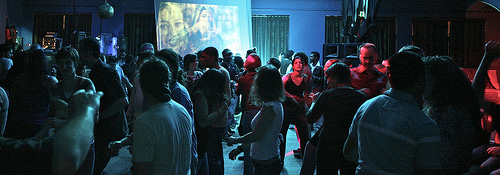
    Thank you to everyone who came down to celebrate with us at our Andaz six-year anniversary party.  If it wasn’t for the hundreds of you showing up every month, we wouldn’t be entering our seventh year at the Fez Ballroom.  We are off to India for two months, but we will be back with all the wickedest beats the subcontinent has to offer for our return party at the Fez Ballroom on January 31st, 2009.  Thank you!

  • India emails from 2004

    Before I begin sending reports from our current India trip, I thought I would share my emails from India in 2004, thus allowing you to compare my trip responses from five years ago, with those I will soon be sharing.

    *****

    Hello all,

    Exhausted.  End of my third full day in Bombay.  All the locals call it Bombay, not Mumbai.  At least the ones I know.  Eating the most amazing home-cooked Indian meals.  Nothing like anything I’ve had at any Indian restaurant anywhere in the US.  And I’m told by my hosts that it is just simple home cooking.  Now I  understand why my Indian friends say it is the food they miss the most when they are in the States.

    Hearing lots of great Hindi songs on the radio that I can’t wait to play at Andaz and Atlas when I get back.  Bhangra is noticeably absent in Bombay; not that many Punjabis.  Am staying with my friend Rajvi’s family.  There is no room in Bombay because of the World Social Forum so we will have to move on soon so as not to overstay our welcome.  Anju’s grandmother’s town awaits.  Jabulpur? Jubalpur? Jabalpur?  Sorry about that.  This gringo is without a travel book at this computer.

    It is so amazing to spend my time with locals.  So much more involving than going from hotel to hotel and restaurant to restaurant like I did in Central America.  Except for Livingston.  (Hello, Marcos!)  Not that that isn’t an amazing, expansive experience as well, I just feel very fortunate.  In just a few days I have experienced so much and had so much insight into another world that I don’t think I could achieve with just a guidebook.

    I hope everyone is well and hopeful about their future.  Even if I were to return tomorrow I would never be the same again.

    All my best,

    Stephen

    *****

    Hello everyone,

    Still making our way across India.  Left Bombay after a week.  Went to Aurungabad which was our base while we visited famous Buddhist and Hindu carved caves at Ellora and Ajanta.  We are currently in Indore, only as a stopover on our way to the ruins of Mandu.  From there we will come back through Indore on our way to Bhopal.  Bhopal is a stopover on our way to the Buddhist stupas of Sanchi.  From there we are on to Anju’s grandmother’s town of Jabalpur.  From there things are much more open.  After spending time with Anju’s family we will try to see either Kanha wildlife preserve or the famously erotic temple sculpture of Khajuraho, or both.  Then up to Delhi for more family and then on to the Punjab.  Depending on our time we will then fly all the way South to the beaches of Kerala and work our way North to Bombay from where we are departing.
    Travel has its share of hassles but everything has worked out fine so far, although you can’t get too hung up about the money flying out of your pants if you want to have a good time.  The home-cooked Gujrati dishes in Bombay have still been the best but we have discovered many other tasty bites.  I’m trying every version of Gobi Manchurian I can get my hands on.  Chinese food is very
    popular here.

    My encouragement goes out to all of Local 5 in our contract struggle.  I here things are continuing with a federal mediator.  I can’t wait to get home and play the Indian CDs I am collecting. Much great dancing awaits.

    My love to everyone,

    Stephen

    *****

    Hello again,

    Anju and I have been in some pretty remote places, some without even phone service, much less internet connections.  Well, when I traveled to Central America I bragged that I didn’t have so much as a loose stool in two months even though I ate off the street for every meal.  I was feeling a little more timid in India having read so much traveller’s health material before leaving.  Well, my first night in Anju’s family home of Jabalpur I got a little too cocky.  I ate some raw tomatoes in a fresh salad and got violently ill for an entire evening.  I was laid out for the whole week.  The good news was that I was laid up somewhere where Anju had family so she wasn’t held captive in a hotel room with nothing to do, but the bad part was that I didn’t end up spending that much time with her family. Anju ended up getting sick later in the week and I was afraid that as long as we stayed in Jabalpur we’d be passing the sick baton back and forth.  Fortunately after getting waitlisted we managed to take a very comfortable train to Jhansi which was on the way to our current location: Khajuraho.  Khajuraho is famous for its erotic temple sculpture and you get little boys on the street trying to sell you postcard books saying, “Hello, Kama Sutra.”  We leave on Friday for Delhi where we will spend at least a week.  We’re hoping to see some of the nightlife since we didn’t make it out to a single club our first week in Bombay.

    I hope everyone is well.  If anyone in Local 5 wants to send me bargaining updates I’d appreciate any info I can get.  Thanks.

    Stephen

    PS Recommended destinations in India: Mandu and Orchha.  Spend at least 3 nights in both places.  Remote and beautiful ruins, each in their own way.

    *****

    Hello everyone,

    I’m in New Delhi now.  It’s been several days and the time passes very fast here.  Because I haven’t been doing too much in the way of sightseeing (excepting the Lodi Gardens and Jantar Mantar) the city seems like one endless parade of varied shopping districts.  Being aware of all the things that either a) exist only in India or b) are so much cheaper than in America or c) both unavailable otherwise and incredibly cheap, I feel a great compulsion to pick things up before my return to the states.  Instead of Spiritual India it is more like Consumer India.  I’ve even been to McDonalds twice which as Anju first stated is 2 more times than in the last decade.  They have a separate all-veg kitchen and everything on the menu is either highlighted red for non-veg or green for veg.  “Veg” and “Non-Veg” are the universal terms for describing your diet in India.  The McAloo Tikki Burger is gross and only the McVeggie Burger with cheese is tolerable.  The McDonalds’ corporate death machine has now acquired a couple more of my dollars in the service of destroying the earth. The fries weren’t even that warm.  P.S. The first time was for curiosity (Punjabis in turbans behind the counter) the second time was because Anju’s cousins wanted to eat there.

    The World Book Fair just happens to be in New Delhi right now all this week.  We made it tonight.  An hour and a half and we barely scratched the surface of thousands of publisher booths and several gigantic halls in a gargantuan conference center of some sort. Despite how slick everything was the bathrooms were something else entirely.  Bathrooms in India are always an interesting experience.

    THE FOLLOWING IS GROSS

    The first bathroom had an inch of water, didn’t flush and shit was smeared on the walls.  I tried one in a different complex and the tank had been broken in half and was leaking all over the floor, a fresh load sitting in the basin.  Needless to say that one didn’t flush either.  There was no soap in the dispensers.  This is at the World’s largest gathering of book publishers.  Just a little bit of India for you there, folks.  I could actually write quite a bit about the bathrooms of India but I feel they are about to kick me out of this internet cafe because it’s closing time.  Oh yeah, you’re always surprised to find toilet paper because most people use the faucet and bucket method.  I have to admit I’ve gained some facility but it is rarely my first choice.  I don’t know how they manage to dry before getting dressed.

    Thanks to everyone who wrote with housing suggestions.  I’m still in the market.

    Signing off,

    The Incredible Kid

    *****

    Hello,

    Anju and I have finally made it to the Punjab.  Because of how close we are getting to the end of our trip we didn’t know if we would have time.  We are in Chandigarh and that is the only city we will be able to see.  The city was designed by Le Corbusier and it reminds me of American housing projects more than anything.  The greens of the trees are beautiful and give a hint of the legendary fertile soils of the Punjab.  We went to the Nek Chand Rock Garden today.  It is a famous construction of recycled materials, lots of porcelain-mosaic people creations and beautiful walks through organic molded concrete walls and the occasional deceptively realistic molded concrete trees blending in with the real ones.  Much nicer and cooler than I thought it would be.

    Since we are here in the middle of the week we are missing out on any bhangra parties.  We just missed a Jazzy B concert by 3 days.  He is Vancouver-born, UK-residing and actually popular in India unlike almost all bhangra not “folky” and native to Punjab.  Our friend DJ Rekha regaled us with stories of a show of his she saw on the East coast and given how much of his music we have been hearing blasted every day in Delhi it is quite disappointing to realise we missed a show of his, and in Punjab no less.

    We are in the home stretch of our trip.  We are returning to Delhi tomorrow and we fly to Pune on the 26th.  Pune is a hip university/IT town with a great party scene apparently.  We will meet up with our friend Rajvi there for a few days.  Then we return to Bombay for a few days before flying back to Portland. There were times when it seemed like the trip would last forever but it is quickly coming to an end.  I realize some people take vacations that are shorter than how much time we have left but when you watch 6 weeks fly by so quickly it is hard to see it as great deal of time.  For those that care we will be playing at Holocene on March 6th shortly after we return for our international night, “Atlas.”

    I mention so little of this trip that if you have any particular questions feel free to ask.  Thanks for reading.

    Stephen

    *****

    Well, Anju and I have less than a week left in India.  We are currently in the college/OSHO city of Pune, Maharashtra.  We are visiting friends and preparing to return to Bombay tomorrow for the final days of our trip.  Our friend Shreeyash introduced us to his friend Marzban who runs a Denon DJ school/DJ Equipment Rental/Ad Agency/Hi-Fi Salon in Pune.  They certify Indian DJs here.  Everyone plays house/trance/techno.  No one has any interest in Indian music here because it is the constant background noise of their existence. Outside of weddings there appears to be little interest in dancing to Hindi or Punjabi music although DJ Arjun in New Delhi hinted at weekday parties for the hardcore.  We’ve only heard bad “Western” music at the few clubs we’ve experienced.

    Some thoughts for those considering a trip to India:

    1)  All the food will be made very bland for you unless you are fortunate enough to eat in people’s homes. Anju and I have only found one restaurant in all our journeys that would serve us moderately spicy food though we begged and pleaded every time we ate.  They completely change the recipes for Westerners, it’s not even a matter of taking out some of the chilies.

    2)  Most restaurants serve Punjabi food which is the same food considered “Indian” food in the states since it was the Punjabis who populated the world after fleeing Partition in 1947.  You will see many of the same dishes you are used to in the states although unfortunately many of the restaurants here (even recommended ones) can’t even prepare edible roti.  Restaurants from the cheapest to the most expensive are consistently disappointing.  Too much can not be said about the vast superiority of home cooking.

    3)  Vegetarians can eat soup in India (It’s very popular and many varieties are on every menu.) because the broth is always vegetable broth.

    4)  There are many, many beggars, from rapscallion children to mothers with small children to lepers to hunchbacks to the limbless.  One is constantly confronted with poverty and desperate pleas for money.  No
    matter how you respond it never feels good.  Nothing changes the lives of these many millions or the overall situation.

    5)  You will not believe the driving at first but you will soon feel comfortable crossing the median into oncoming traffic while dodging cows, pedestrians, scooters, auto rickshaws and other cars.  So far we have only collided with one scooter in an cycle rickshaw.  We escaped with bruised knees.

    6)  If you are white you are a target.  People will constantly try to sell you something or get something from you.  People will either be incredibly rude or try to convince you they’re you’re friend.

    7)  Things are so polluted the sun usually disappears long before it
    hits the horizon.

    8) There are always fireworks and loud marching bands because these always accompany weddings.

    9)  I have a hard time understanding Indian English, Indians have trouble understanding me, and I often can’t tell if I’m being spoken to in Hindi or English.

    10)  If you plan to travel in Central or Northern India take the time to learn some Hindi.  I feel like you are not even considered human until you show that you know some Hindi.  Until then you are just fleshly transport for your wallet.

    11)  I hope to be back for much longer periods of time.  There is far, far too much to see in several months. India is amazing.

    Thanks,

    IncKid